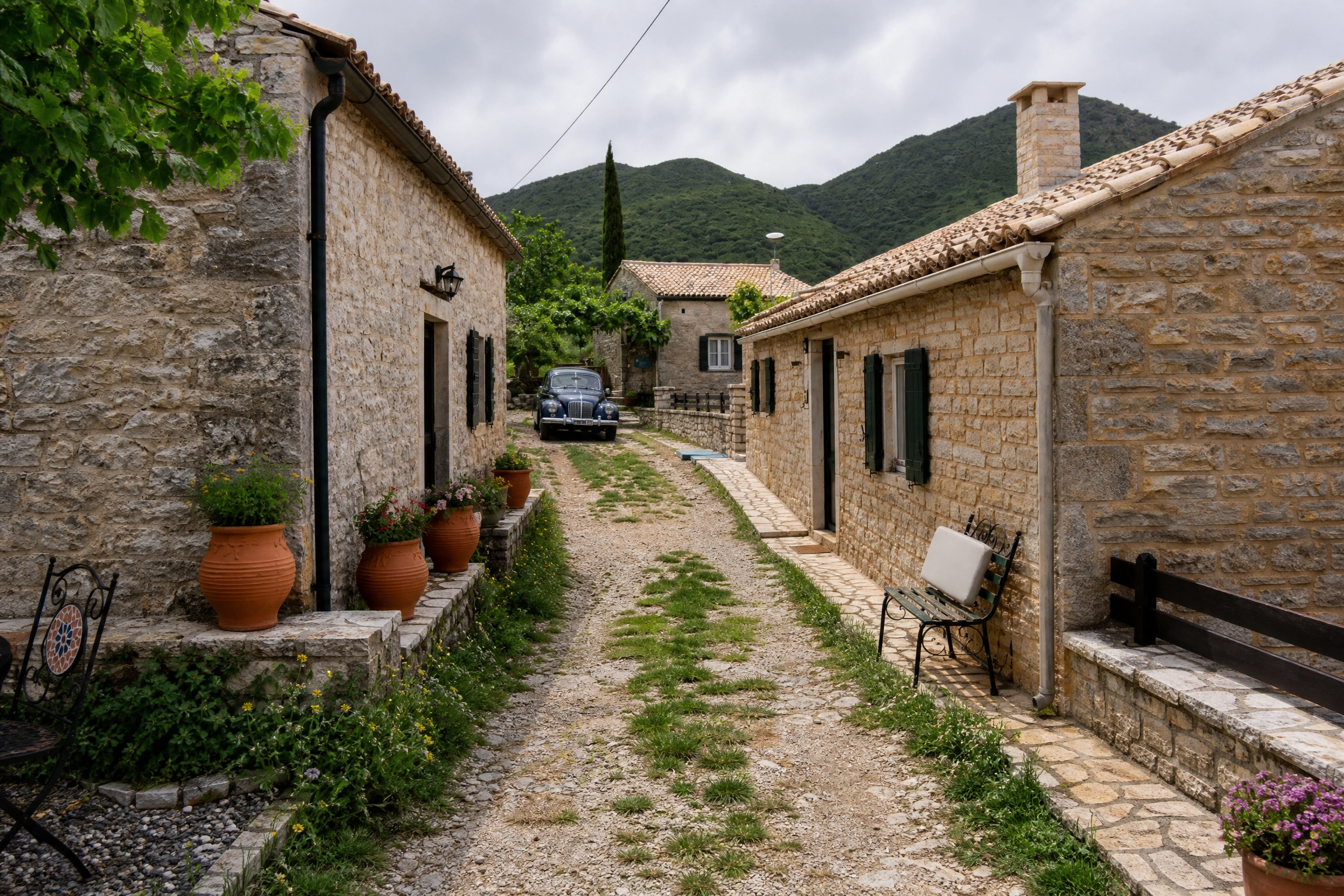
Why Corfu's Interior Is Unreachable Without a Rental Car
Corfu's bus network, run by KTEL, connects the coastal resort strip and Corfu Town. It does not reach the inland villages. This is not a gap that is changing. The communities living in the mountains and the olive-covered southern hills have no particular economic relationship with summer tourism, and the road network that serves them reflects that. Most visitors spend their entire trip between the beach and the old town and never know what they are missing.
The interior road network itself is in reasonable condition. The roads are paved, mostly, and a standard rental car handles all of them without issue. The problem is simply that without your own transport, there is no practical way to get to these places and get back. What follows covers ten villages that are genuinely inaccessible by public transport, with honest notes on what is actually there, the best time to go, and what to combine on the same day.
10 Corfu Villages You Can Only Reach by Car
Each entry covers what is specifically true about the place, not a rephrasing of what other guides say about it.
Old Perithia
Corfu's oldest surviving settlementOld Perithia sits on the northern flank of Mount Pantokrator at around 400 metres. The village dates to at least the 14th century, built deliberately high so that pirate raids coming up from the coastline had no practical chance of reaching it. That logic held for roughly 600 years. By the 1960s, the last families had moved down to the coast for the schools, the jobs, and the water supply, and the village went quiet.
What is there now: around 130 stone houses in varying states of repair, eight small churches including the well-preserved Agios Iakovos, and a handful of tavernas that have opened inside the old buildings over the last two decades. The food at these tavernas is genuinely good. Slow-cooked meat, local wine, bread baked on site. The surrounding silence is of a quality that no curated experience can replicate. It is a protected heritage site and visitation is lower than you would expect given how extraordinary it is.
One thing most guides miss: the road from Loutses to Old Perithia changes character noticeably as you climb. From dry scrub near the coast, it moves through dense oak and chestnut forest near the top. The drive is not an inconvenience before the destination. It is part of the visit.
Sokraki
The highest village on the island, at 440 metresSokraki is the highest inhabited village on Corfu, sitting at 440 metres in the central-northern hills. It is small, with a few dozen year-round residents, a traditional square, stone houses painted in faded ochres and terracottas, and two or three kafeneia where sitting long enough that the concept of a schedule stops feeling relevant is entirely possible.
The specifically Corfiot detail worth knowing: ginger beer. Corfu is one of the only places in Greece with a ginger beer tradition, a legacy of the British Protectorate period from 1815 to 1864. In Sokraki and a handful of other mountain villages it is still made and served in the old way. It is not the sweet carbonated British variety. It is closer to a cold, lightly fermented ginger drink, sharp and aromatic, not particularly sweet. Worth ordering specifically if you have not had it before.
From Sokraki, hiking trails run deeper into the Pantokrator range. The 16th-century churches scattered through the alleys are unlocked on feast days and occasionally at other times if you ask at the kafeneion.
Nymfes
The waterfall that runs through summerThe name comes from the nymphs of Greek mythology. The valley below the village was said to be their bathing place, fed by the waterfall in the trees. The geology makes this more than legend: the Pantokrator massif retains groundwater long after surface rainfall has stopped, which is why the falls at Nymfes continue to flow through summer when every other stream on the island has gone dry. In August, finding running water in a shaded hollow on a Greek island is not common.
The village is 30 kilometres north of Corfu Town, built on the shoulder of a green valley with the mountain above and the olive groves below. The vegetation around the trail to the falls, oak, holly and wild fig, is dense enough to drop the temperature by several degrees. You hear the water before you see it. The walk from the village takes 10 to 15 minutes on foot over an unpaved path. Closed shoes are the practical choice.
Lakones
The ridge above Paleokastritsa with the full panoramaLakones sits on the ridge directly above Paleokastritsa, the village you are looking up at from the famous bays below. The elevation gives it a view that most visitors to Paleokastritsa never see from the correct angle: all six of the monastery bay's inlets at once, the colour gradient from turquoise to deep blue-green, and the open Ionian stretching west toward Italy on clear mornings. The Bella Vista terrace has been receiving visitors for this view for generations and the view has not diminished.
Beyond the panorama: stone lanes, houses with bougainvillea over the doorways, a modest bell tower, and traditional tavernas where the octopus dries on lines in the afternoon sun rather than arriving frozen from a distributor. The village is real rather than arranged for visitors. The road up from Paleokastritsa is steep and narrow, the kind of road where you quickly understand why a small car handles it more comfortably than a large one.
Doukades
An inland village that has not adjusted itself for visitorsDoukades is a few kilometres from Lakones, sitting in a natural bowl between forested hills. It has none of Lakones' famous panorama and consequently receives considerably fewer visitors, which is exactly what makes it worth including. The village has a large, shaded central square anchored by a striking church. Local life happens here without modification for an audience: elderly men at the kafeneion, cats flattened across warm stone walls, a grocer who will sell you local olive oil if you ask about it directly.
There is no particular attraction in Doukades. That is not an evasion. The village is what villages in the Corfiot interior are like when they are not trying to be anything for a visitor. You sit, you order something, an hour passes. It is one of the more honest experiences on the island.
Spartilas
Starting point for the Pantokrator summit hikeSpartilas is at around 360 metres in the mountains above Ipsos and Barbati. If you have stayed on the north-east coast and looked up at the mountain wall behind the resort strip, you have been looking toward Spartilas. The village has a traditional square, a 16th-century church dedicated to Agios Minas, and a small number of places to eat that serve Corfiot food: sofrito (veal cooked in white wine and garlic), pastitsada (slow-cooked meat with pasta), and the occasional bourdeto (spiced fish stew) depending on the day's supply.
Spartilas is also one of the most practical starting points for the hike to the Pantokrator summit at 906 metres. The summit has a monastery and a telecommunications tower. On a clear day from the top, you can see north to the Albanian mountains and south over the full length of the island. The round trip from Spartilas takes 2 to 3 hours on a marked trail. If you are planning an active visit, the best things to do in Corfu guide covers more options across the island.
Chlomos
360-degree views of both Corfu coastlinesChlomos sits between 270 and 320 metres on the slopes of Mount Morovigli in the south. On a clear day you can see both the east coast (the calm channel between Corfu and the Albanian and Greek mainland) and the open Ionian to the west simultaneously from the village. That is not a figure of speech or a marketing claim. It is a consequence of the village's position on a ridge rather than a slope. Paxos and Antipaxos sit as distinct shapes on the southern horizon in good visibility.
The historical detail: the mansion in the village belongs to the line of Thomas Palaiologos, the brother of Constantine XI, the last Byzantine emperor. The Byzantine and subsequent Venetian occupation of the village is still architecturally present in the stone houses. The external staircases, the arched ground floors, the window proportions. It is a 13th-century settlement with 600 years of layering on top of it. The main square has kafeneia and a taverna. The food is simple and not oriented toward visitors.
Agios Mattheos
A working inland market town in the southwestAgios Mattheos, known locally as Ai Mathias, is a proper inland market town rather than a picturesque hamlet. At around 150 metres behind Mount Gamelio in the southwest, it has a functioning butcher, a baker, several family-owned tavernas, and a weekly market that draws the surrounding farming community in. No souvenir shops. No menus in English. The wine is from a barrel and the price is the same for everyone.
The surrounding land is olive and citrus country. The Korission Lagoon, one of the largest wetland nature reserves in the Ionian, is a short drive away. It is a protected area where flamingos appear in autumn and winter, along with a significant variety of wading birds on migration. The long undeveloped beach at Halikounas, which borders the lagoon on its western edge, is among the least visited stretches of sand on the island despite being genuinely fine.
Kynopiastes
The village known for traditional Corfiot cookingKynopiastes is in the olive-covered hills southwest of Corfu Town. The village's family tavernas use produce from the land immediately around them and serve the dishes that define Corfiot cuisine with a standard that tourist-facing restaurants in town rarely match.
The specific dishes worth knowing before you arrive: sofrito is thinly sliced veal cooked in white wine, garlic, and vinegar, not the tomato-based stew that some restaurants pass off as sofrito. Bourdeto is fish in a broth made intensely red and spiced with paprika and chilli, a preparation specific to Corfu. Pastitsada is a slow-cooked rooster or veal dish built on a spiced tomato sauce served over pasta. These are not variations on mainland Greek cooking. They are Corfiot specifically, with Venetian and French influence worked in over four centuries of different administrations.
Coming here for dinner requires a rental car. No bus reaches the village at usable evening times. Book a table in high season.
Afionas
Clifftop village above Porto Timoni on the northwest coastAfionas occupies the tip of a small peninsula on the northwest coast, between two bays. Most people pass through it en route to Porto Timoni, a double-bay beach that photographs well and appears frequently in Corfu imagery, and do not stop in the village itself. That is a reasonable choice if Porto Timoni is the goal, but the village deserves more than a parking stop.
The square is quiet. A church sits directly above the cliff edge with an unobstructed view over open sea. A handful of old houses face west and catch the light in the late afternoon in a way that is specific to cliff-edge sites facing the Ionian. In the early morning before day-trippers arrive, or in the early evening after they have left, Afionas has a quality of light and quiet that is genuinely hard to find elsewhere on the northwest coast.
The hike down to Porto Timoni takes around 20 minutes over moderate rocky terrain. The double bay at the bottom is as good as the photographs suggest. The single-track road to Afionas means parking at the village and walking is the only arrangement.
How to Plan a Day Trip to Corfu's Inland Villages
A few things that are specifically true about driving Corfu's interior, rather than general advice about renting a car abroad.
Why the bus does not reach these places
Corfu's KTEL bus network is designed around the coastal resort strip and Corfu Town. Interior routes that do exist run on schedules that make return trips impractical for a day visit. This reflects the economics of a dispersed rural population and will not change. A rental car is the only realistic option.
What size car to rent
An economy hatchback handles every road on this list. Larger vehicles struggle on the hairpins above Sokraki and Chlomos. The final approach to Old Perithia involves a rougher surface than the rest, nothing that requires four-wheel drive, but noticeable. A standard small car is the correct choice, not an upgrade.
Horn etiquette on mountain roads
Corfu's mountain road culture uses the horn as a warning on blind bends, not as an expression of frustration. Single-track roads with no passing space mean you signal before a curve so oncoming traffic knows you are there. If a local sounds their horn before a bend, mirror it. It is a courtesy, not aggression.
When to go: seasonal advice
May, June, September and October are the best months. In high summer the midday heat in villages above 300 metres is 5 to 7 degrees cooler than the coast, which makes driving inland an argument for July and August rather than against it. The Corfu in May guide and the Corfu in April guide cover the shoulder season in detail.
How to group the villages into day trips
Three natural groupings: northwest (Lakones, Doukades, Afionas) as one loop. North and central (Old Perithia, Sokraki, Nymfes, Spartilas) as a full day from the north coast. South (Chlomos, Agios Mattheos, Kynopiastes) as an afternoon into evening, finishing with dinner. See the full Corfu activities guide for more context.
Who can rent with UNO Corfu
Rentals from 18 years old. No credit card required. Free additional drivers, relevant if you are sharing the driving on a full day of mountain roads. Contact the team with any pre-booking questions.
Frequently Asked Questions About Corfu Village Road Trips
Can you visit these villages without a car?
Are the mountain roads in Corfu safe to drive?
Which village has the best food?
What is the best time of year to visit Corfu's inland villages?
Is Old Perithia worth the drive?
How old do you need to be to rent a car with UNO?
Ready to Explore Corfu's Interior?
Pick up your car directly at Corfu Airport. No credit card required. Rentals from 18 years old. Free additional drivers.
Browse Our FleetQuestions before you book? Contact the UNO team.



Udostępnij:


Related Articles


Planning this route?
We can help you choose the right car for Corfu
If your itinerary includes villages, beaches or mountain roads, browse the fleet or ask us directly which category fits best.